
Introduction
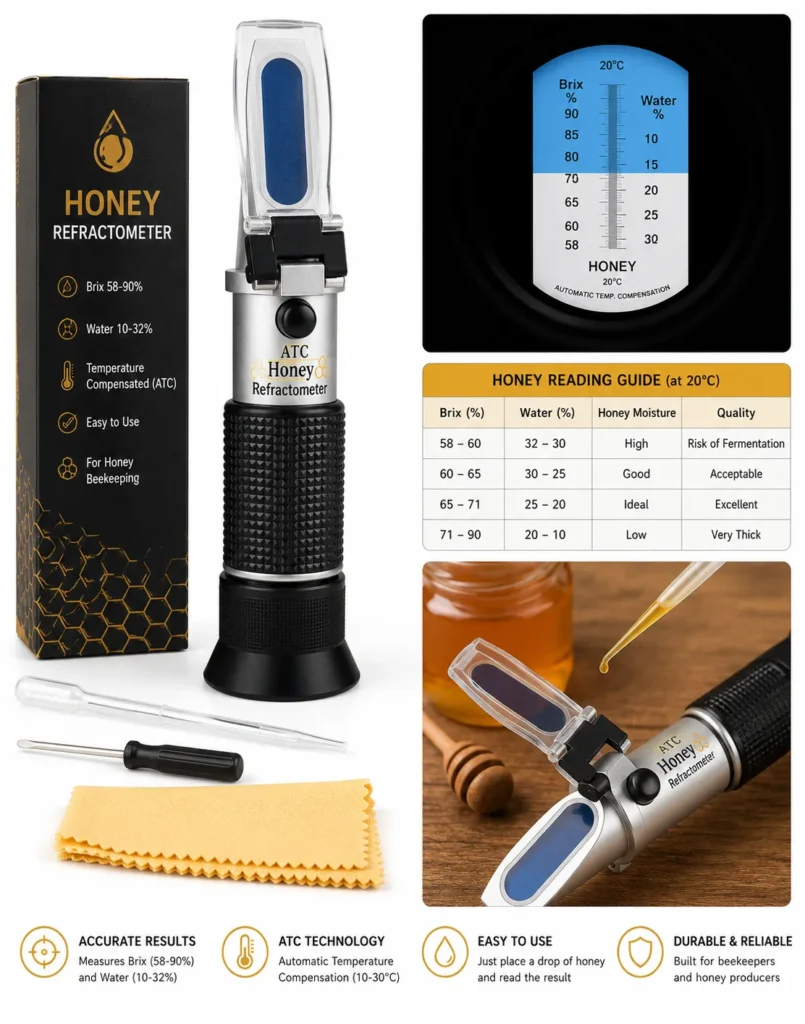
A honey refractometer is an essential tool used in honey production to measure the moisture content of honey. Maintaining the correct moisture level is critical because it affects honey quality, shelf life, taste, and resistance to fermentation.
Beekeepers and honey producers use refractometers to ensure that honey meets quality standards before packaging and distribution.
What Is a Honey Refractometer?
A honey refractometer is a precision instrument that measures how light passes through honey. Based on this measurement, the device determines the moisture content of the honey sample.
This simple test helps producers verify that honey is properly ripened and ready for storage or packaging.
Why Is a Honey Refractometer Important?
Ensures Honey Quality
Accurate moisture measurements help maintain product consistency and quality.
Prevents Fermentation
Excess moisture can cause honey to ferment and spoil over time.
Supports Long-Term Storage
Proper moisture levels improve shelf life and product stability.
Helps Meet Industry Standards
Many honey producers use refractometers to comply with quality control requirements.
How a Honey Refractometer Works
Sample Collection
A small drop of honey is placed on the refractometer prism.
Light Measurement
The device measures how light refracts through the honey sample.
Moisture Reading
The refractometer displays the moisture percentage.
Quality Assessment
The beekeeper determines whether the honey is ready for packaging or requires additional ripening.
Features of a Honey Refractometer
Accurate Measurements
Provides reliable moisture content readings.
Quick Testing
Results are available within seconds.
Portable Design
Easy to carry and use in apiaries, processing facilities, and packaging units.
User-Friendly Operation
Simple testing procedure requires minimal training.
Benefits of Using a Honey Refractometer
Improved Product Quality
Ensures honey reaches consumers in optimal condition.
Reduced Spoilage Risk
Helps identify honey with excessive moisture before storage.
Better Quality Control
Supports consistent production standards across batches.
Increased Consumer Confidence
Quality-tested honey builds trust and satisfaction among customers.
Ideal Honey Moisture Levels
Most high-quality honey contains a moisture content of approximately 17% to 20%.
Honey with lower moisture levels is generally more stable and less likely to ferment during storage.
Importance in Honey Production
The honey refractometer is one of the most important quality control tools in modern beekeeping and honey processing. It helps producers verify that honey has matured properly and is suitable for long-term storage and packaging.
Without moisture testing, honey quality can become inconsistent and spoilage risks may increase.
Conclusion
A honey refractometer is an essential instrument for measuring honey moisture and maintaining quality standards. By helping producers prevent fermentation and ensure proper ripening, it plays a vital role in delivering safe, fresh, and high-quality honey.
At Homely Harvest, we use quality control practices and professional testing methods to ensure that every jar of honey meets our standards for purity, freshness, and excellence.
Call to Action
Choose Pure, Choose Homely Harvest.
Enjoy quality-tested natural honey that is carefully monitored, expertly processed, and delivered fresh from our hive to your home.