
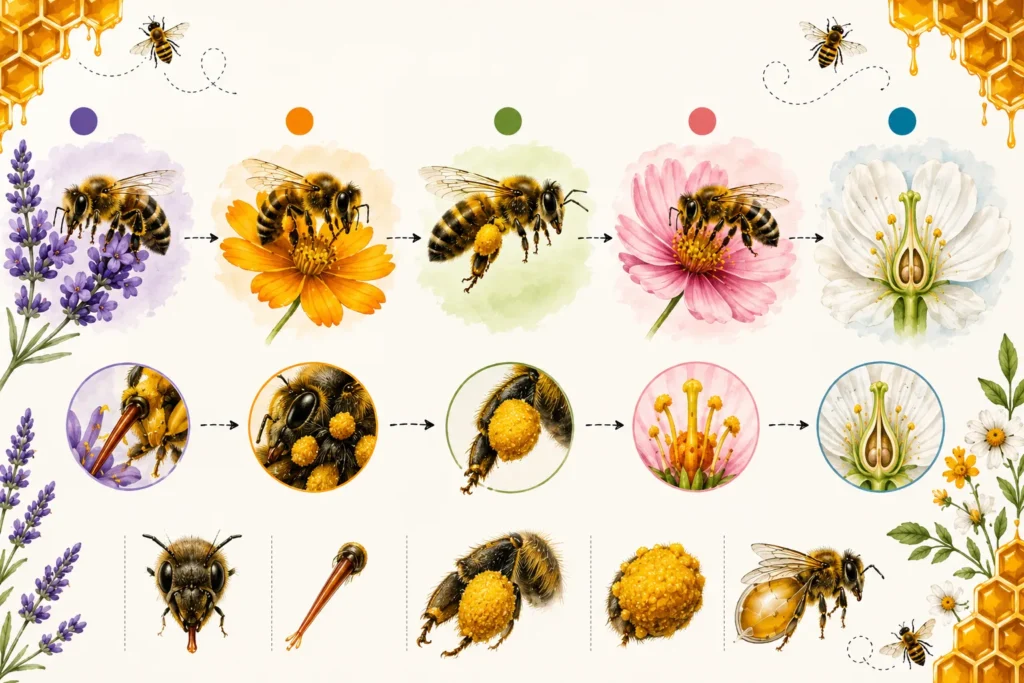
Nectar transfer is a crucial stage in the honey-making process. It begins when worker bees collect nectar from flowers and continues as the nectar is transported, processed, and stored within the hive. During this process, natural enzymes transform the nectar, preparing it for conversion into pure honey.
Understanding nectar transfer helps reveal the remarkable teamwork of honeybees and the natural processes behind every drop of pure honey.
What Is Nectar Transfer?
Nectar transfer refers to the movement of nectar from flowers to the hive and its subsequent processing by worker bees. This process allows nectar to be transformed into a stable food source that supports the colony and eventually becomes honey.
Through collection, enzyme activity, and storage, bees convert flower nectar into one of nature’s most valuable foods.
Collection and Transport
The first stage of nectar transfer involves gathering nectar from flowering plants and transporting it back to the hive.
Worker Bees Carry Nectar
Worker bees visit flowers and collect nectar using their specialized mouthparts. The nectar is stored in a special honey stomach, separate from the bee’s digestive system.
From Flowers to the Hive
After collecting nectar, worker bees return to the hive carrying their valuable cargo. This transportation stage ensures that the collected nectar reaches the colony for further processing.
Processing and Mixing
Once inside the hive, the nectar undergoes important changes that prepare it for honey production.
Passing Between Worker Bees
Forager bees transfer nectar to house bees through a process of exchange. This movement of nectar between worker bees helps distribute and process the collected resource efficiently.
Natural Enzymes
During transfer, bees mix the nectar with natural enzymes produced by their bodies. These enzymes play a vital role in transforming nectar into honey.
Breaking Down Complex Sugars
The enzymes help break down complex sugars into simpler forms, making the nectar easier to preserve and store.
Preparing Nectar for Conversion
The enzymatic activity begins the conversion process that ultimately results in mature honey.
Storage and Ripening
After processing, the nectar enters its final stage before becoming honey.
Honeycomb Cells
Worker bees place the processed nectar into hexagonal honeycomb cells. These cells serve as natural storage containers within the hive.
Moisture Evaporation
Fresh nectar contains a high amount of water. Bees reduce the moisture content through ventilation and natural evaporation, helping prevent spoilage.
Pure Honey Formation
As moisture levels decrease and enzymatic activity continues, the nectar gradually ripens into pure honey. Once fully matured, the honey is sealed within the honeycomb using a wax cap.
Why Nectar Transfer Matters
Nectar transfer is essential for both honey production and colony survival. Without this process, bees would be unable to create the food reserves needed to sustain the hive.
The transfer and processing of nectar ensure:
- Efficient food storage
- Long-term colony survival
- Natural honey production
- Preservation of nutrients and flavor
- Sustainable hive management
The Connection to Pure Natural Honey
Every jar of pure natural honey begins with nectar transfer. The careful work of worker bees, combined with natural enzymes and hive conditions, creates the rich, flavorful honey enjoyed around the world.
This remarkable process demonstrates the complexity and efficiency of honeybee colonies and their contribution to nature.
Conclusion
Nectar transfer is one of the most important stages in honey production. From collecting nectar in flowers to storing ripened honey in honeycomb cells, bees perform a series of precise and coordinated actions that transform nectar into pure honey.
At Homely Harvest, we value these natural processes and the incredible work of honeybees that make high-quality honey possible.
Call to Action
Choose Pure, Choose Homely Harvest.
Experience the taste of naturally produced honey crafted through the remarkable journey of nectar transfer.